

Alan’s Full Circle Moment

As Wayne Law’s business curriculum expanded, responding to the needs of Michigan’s growing firms, Schenk’s own courses evolved. Alongside a colleague, he helped develop a Business Planning course designed to equip students with practical tools for the transition into practice. When the American Bar Association later mandated skills training and clinics, he observed how the profession’s expectations shifted back into the law school curriculum—transforming legal education nationwide.


He also shared how his “accidental” interest in value added tax opened doors across the globe—drafting foreign tax laws, teaching internationally, and serving as an expert in reform efforts. Those experiences, he said, only deepened his appreciation for the students of Wayne Law.
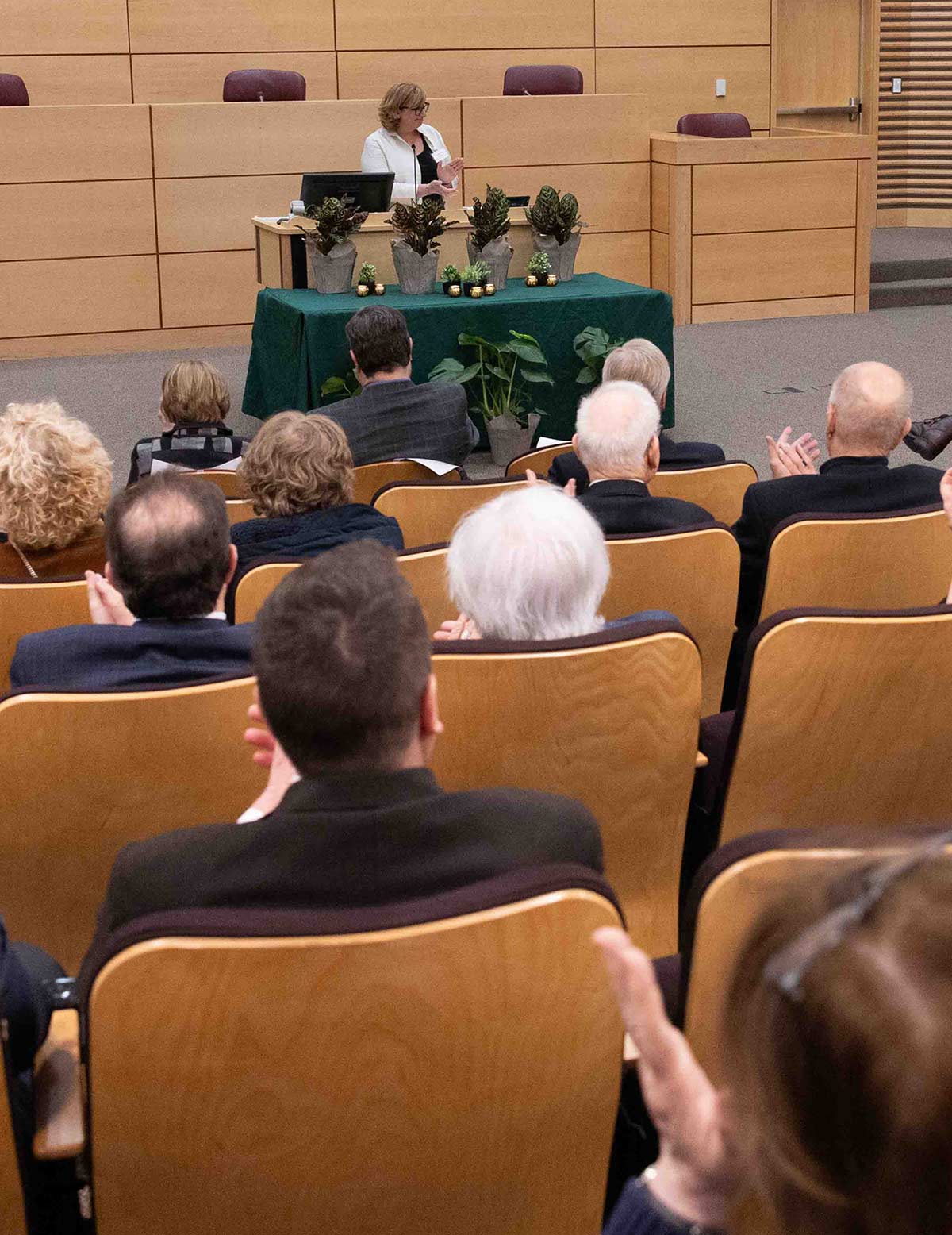
The evening concluded with a standing ovation and a thoughtful Q&A session, a fitting tribute to a career defined by dialogue and dedication.


Professor Alan Schenk has devoted his academic life to tax law and is widely regarded as an international expert on value added taxation (VAT). A member of the Michigan bar, the U.S. Tax Court, and the U.S. Supreme Court, and a certified public accountant, Schenk’s credentials reflect both scholarly rigor and professional depth.
He taught Federal Income Tax, Business Planning, Accounting for Lawyers, and Consumption-Based Taxes. He served as a professor-in-residence in the IRS Office of Chief Counsel from 1984 to 1985. He co-taught VAT courses at leading institutions, including Harvard Law School and University of Michigan Law School, as well as Duke University’s Sanford School of Public Policy.

His scholarship is equally distinguished. He authored or co-authored five books on value added tax, including Value Added Tax: A Comparative Approach (2d ed., 2015), published by Cambridge University Press. His articles have been published internationally, including work on the taxation of financial services that appeared in the Tax Law Review and in Japanese publications.
At Wayne State University, his excellence in teaching and scholarship earned him numerous awards, including the President’s Award for Teaching. He was appointed Distinguished Professor in 2011 and inducted into the university’s Academy of Scholars in 2019.
For decades, he has quietly and meticulously preserved the history of the law school. His office is filled with documents, photographs, publications, and artifacts dating back to the 1920s, serving as an unofficial archive of the institution’s earliest days. He is the school’s resident historian; the person faculty and administrators turn to when a question about the past arises.
In 2022, the Wayne State University Press published his book, Detroit’s Wayne State University Law School: Future Leaders in the Legal Community. Unlike many institutional law school histories that center on deans, physical changes and curricular shifts, Schenk’s work highlights the students. He documents how a night-only public law school admitted students without regard to gender, race, or ethnicity at a time when many elite institutions excluded women, people of color, and Jewish applicants.
He chronicles how those students pushed for curricular expansion, demanded opportunity, and ultimately reshaped the school’s reputation. The book reflects not only careful archival research but also recorded interviews with alumni, deans, and professors. Through this work, Schenk ensured that Wayne Law’s story would not be lost to time.

His scholarship continues to shape conversations about tax policy worldwide. His historical work safeguards Wayne Law’s institutional memory.
He often emphasized that Wayne Law’s strength lies in its students: their resilience, diversity, and determination. In telling the school’s history and reflecting on his own, he reminded the audience that institutions are built not only by buildings or budgets, but by people committed to teaching, learning, and serving.
As the event concluded and the applause overtook the space, one truth was clear: Alan Schenk is a pillar of Wayne Law. His legacy will endure in classrooms, in scholarship, in the pages of history he preserved, and in the countless lawyers he helped shape over sixty remarkable years.