


Reflections on Michigan’s Marriage Equality Case Ten Years After Obergefell
After narrowly avoiding a catastrophic auto accident, April and Jayne decided they had to do something so that if anything happened to one of them, the other could continue parenting all three children. At the same time, Dana Nessel, who was subletting an office in my law firm’s suite, was looking for clients to challenge Michigan’s adoption law in federal court. April and Jayne were ideal plaintiffs. Their family story was compelling, and both were sympathetic, thoughtful, and articulate, albeit shy about publicity, especially Jayne.
One day Dana asked if I would help with the case she was planning. I immediately said yes. My practice had long concentrated in professional ethics and criminal defense, but I had also done a lot of pro bono civil rights work. Dana also asked Carole Stanyar, another colleague sharing office space, to help. Carole also promptly agreed.
Carole is an accomplished litigator whose courtroom competitiveness is part of her DNA. She had been captain of the Yale women’s basketball team and still played hockey in Ann Arbor. Both Carole and I had extensive federal trial and appellate experience, including both having argued in the U.S. Supreme Court. Dana, formerly an assistant prosecutor in Detroit, was known as a passionate advocate for victims. The fourth member of our team, Wayne Law Professor Bob Sedler, had written a prescient 2003 law review article arguing that laws prohibiting same-sex couples from marrying were unconstitutional.
We hoped the lawsuit would move the law forward incrementally. In 2012, the notion that same-sex couples should have the right to marry was bitterly controversial. Eight years earlier, 59% of Michigan voters had approved a constitutional amendment banning same-sex marriage.
We filed our suit in January 2012 against Governor Rick Snyder, represented by Attorney General Bill Schuette. One of Schuette’s first steps was to ask the court to dismiss the case.
The case was assigned to U.S. District Judge Bernard Friedman. Carole and I had both appeared before him many times, but we didn’t know how he would view this case. As Carole argued against the motion to dismiss, Friedman appeared unmoved, then asked a question we never anticipated:
“Ms. Stanyar, aren’t you really challenging the marriage amendment?”
“I understand that’s how you’ve framed your argument, but isn’t your objection really that they cannot marry? Would you like to amend your complaint to add that claim?”
This was a now-what-do-we-do moment. The judge had thrown cold water on our argument but offered a lifeline. We were terrified that if we challenged the marriage amendment prematurely and lost, we would set back the struggle for marriage equality nationally. But what about April and Jayne’s children? We amended the complaint.
Challenging the marriage ban drastically changed the arc of the case. We added the Oakland County clerk as a defendant, but after Lisa Brown defeated the incumbent in November 2012, she aligned with our position, replacing the county’s lawyers with volunteer civil rights attorneys.
Challenges to marriage bans elsewhere relied on two main arguments. One, Sedler’s thesis: denying same-sex couples the right to marry was unlawful sex discrimination, grounded in Supreme Court decisions influenced by Ruth Bader Ginsburg and Pauli Murray. Two, marriage is a fundamental right, so states must show a compelling reason to deny it. We now had the chance to press and expand these arguments.
Thinking about what makes marriage fundamental led me to reflect on my own marriage. My parents had wanted me to marry a “nice Jewish girl.” Instead, I married Maureen Shaughnessy, a wonderful Irish Catholic woman. Unlike April and Jayne, no one told us our different religious backgrounds barred marriage. Our right to marry didn’t depend on children, adoption, parenting skills, cohabitation, or even love. Stripped of cultural and religious practices, marriage is a civil contract that doesn’t distinguish rights or duties based on gender.
By the time of our lawsuit, decades had passed since marriage law ceased to distinguish the parties’ rights by gender. This evolution of marriage law strengthened our fundamental right argument: religions may impose rules for their members, but if marriage law doesn’t distinguish based on gender, how could the state deny same-sex couples the right to marry?
Taken aback, we gathered in a dinged-up conference room across the hall, asking how we would find and prepare experts or pay for them. Unlike other pending marriage equality cases, we had no organizational backing—just a small, determined team operating on a shoestring.
Our opponents’ arguments followed the usual playbook: Children raised by same-sex couples fare worse, or there’s too little research to know. Judge Friedman’s trial order forced the state to put up or leave the record blank. It also resulted in the only evidentiary record later relied on by the Supreme Court in Obergefell.
We prepared for trial with a clear sense of expert areas: sociology, history of marriage, and child outcomes in foster care. I contacted Michigan ACLU legal director Michael Steinberg, a long-time friend, to help secure national experts. After a tense call, the national ACLU agreed to support us. Leslie Cooper, a national ACLU attorney, later joined our team and cross-examined the state’s key expert, University of Texas sociologist Mark Regnerus, whose study suggested negative outcomes for children of same-sex parents.
We also received enormous support from Mary Bonauto of GLAD, known as “the Thurgood Marshall of the marriage equality movement,” and law student volunteers from the University of Michigan and Yale. Our expert slate included psychologist David Brodzinsky, demographer Gary Gates, Harvard historian Nancy Cott, Stanford sociologist Michael Rosenfeld, and University of Michigan law professor Vivek Sankaran.
The trial began in February 2014, during a bitterly cold polar vortex. Inside the courtroom, the contrasts in scholarship and credibility became stark. The day before Regnerus testified, his department chair publicly denounced his study as “fundamentally flawed.” Another state expert, Douglas Allen, lost credibility when he admitted personal religious bias affected his views. Sherif Girgis, another state witness, was dismissed for lacking basic expert qualifications.
After a two-week trial, I delivered our closing argument, labeling the state’s experts “a desperate fringe.” Judge Friedman agreed, writing in his opinion that they “clearly represent a fringe viewpoint rejected by the vast majority of their colleagues across social science fields.”
Our victory was intertwined with personal, uplifting moments. A supporter told us, “We’ve never had anyone fight for us before.” Carole remarked, “You can feel the shame lifting.” Judge Friedman issued his decision after 5:00 pm on a Friday without including a stay. As a result, about 300 couples were able to marry over the next eighteen hours, supported by several county clerks who kept offices open late and on Saturday until the Sixth Circuit issued a stay. Among them were two men who had been together twenty years, proudly claiming “we’re number five in line” for the next morning.
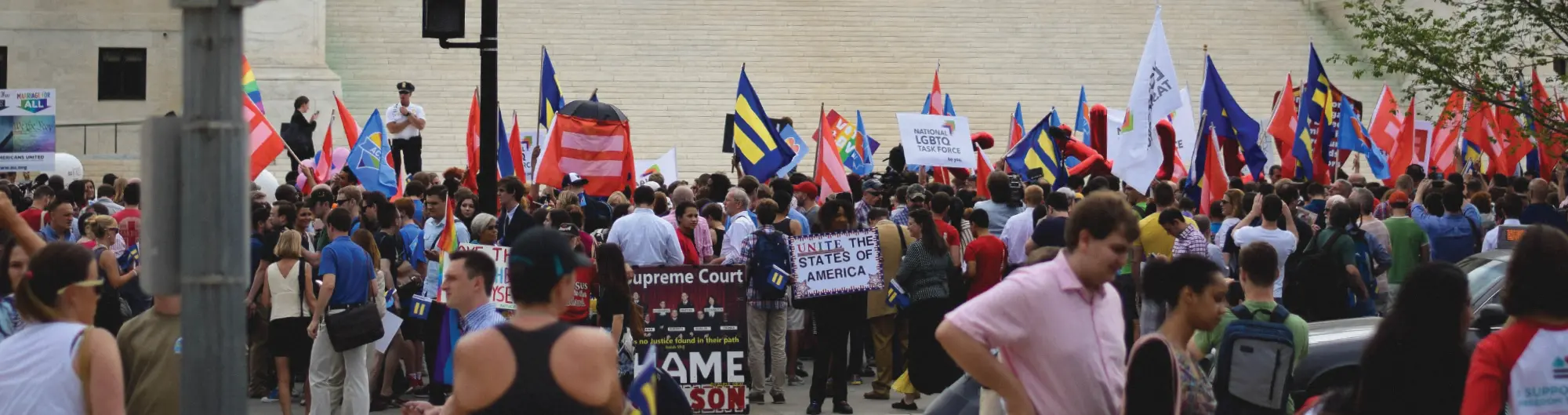
On April 28, 2015, Mary argued before the Court. She fielded hostile and supportive questions alike, including Justice Scalia’s pressing on issues like whether priests would have to officiate at same-sex marriages. Opposing counsel John Bursch, stumbled, likely offending even Chief Justice Roberts — the father of two adopted children — by trying to distinguish between adopted and biological children. Outside, the plaza overflowed with rainbow banners, choirs, and celebratory crowds.
On June 26, 2015, the Supreme Court ruled 5–4 in favor of same-sex marriage. Justice Kennedy’s opinion affirmed the dignity and rights of LGBTQ+ partners and their families. In Ann Arbor, our team and supporters gathered to celebrate, laugh, hug, and cry. Each legal team member signed copies of the Court’s decision for posterity. That summer, Judge Friedman officiated April and Jayne’s wedding, with each of us on the legal team signing as witnesses.
By the time the case ended, April and Jayne had adopted two more children. Carole and I resumed the rest of our law practice, Bob continued teaching until retirement, and Dana successfully ran for Michigan Attorney General and was reelected in 2022. My own family was touched: our youngest daughter and oldest grandson came out, married, and celebrated without an asterisk—in each case their celebration was “just” a wedding.
Dr. Martin Luther King Jr. said, “The arc of the moral universe is long, but it bends toward justice.” On June 26, 2015, that arc became a rainbow.